
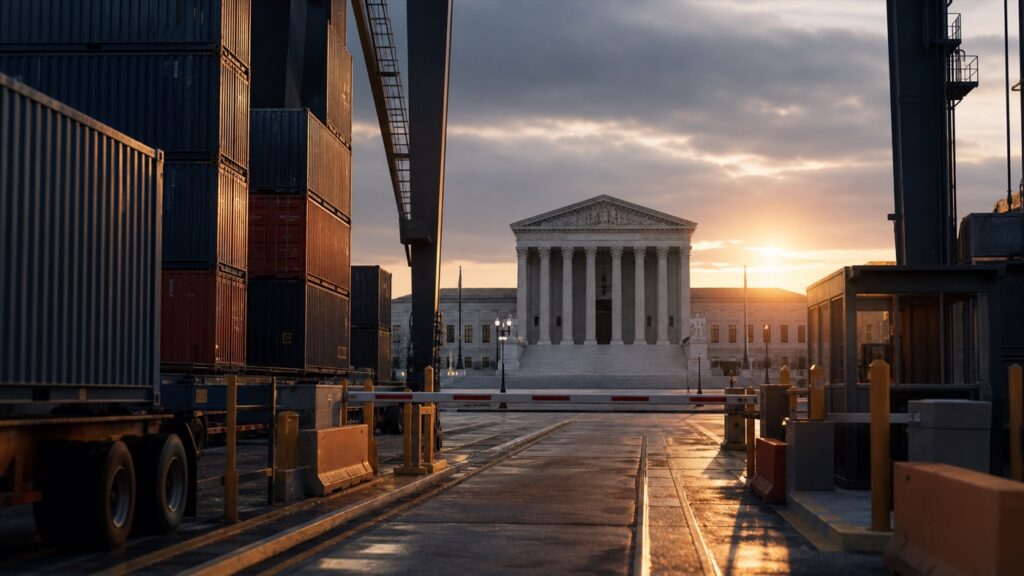
Trade & Washington
Twenty-five states have asked a federal trade court to block the administration’s new Section 301 tariffs, arguing that a forced-labor rationale is being used to impose broad import taxes. The legal question is large, but the near-term business reality is simpler: unless a court grants relief, the duties remain part of the landed cost of imported goods.
The practical conclusion: households should not assume an immediate price shock or an immediate court reversal. Importers should map exposure by country and product, preserve entry records, review contract language, and follow the court docket and Customs guidance. The case may redefine presidential trade power, but litigation does not suspend a tariff by itself.
What Happened
On August 3, 2026, a coalition of 25 states filed a lawsuit challenging tariffs the administration announced under Section 301 of the Trade Act of 1974. Associated Press reporting describes rates of 10% to 12.5% on imports from 59 countries and the European Union. The states contend that the action is too broad for the authority Congress delegated and that the stated forced-labor justification is a pretext for a general tariff program.
The administration says the action is lawful and tied to investigations into foreign economies’ alleged failure to address forced labor. The White House action describes the measures as responses to practices found actionable under Section 301. Those competing legal descriptions are claims before a court, not settled findings.
What the Tariff Action Contains
Section 301 allows the United States Trade Representative to investigate foreign acts, policies, or practices and, after required procedures, recommend responsive action. The new measures apply country-level additional duties rather than a narrowly named consumer product list. According to the public announcement and reporting, the covered trading partners account for about 99% of U.S. imports, making the potential commercial reach unusually wide.
A tariff is collected from the importer of record at the U.S. border. That firm may absorb the charge, negotiate a lower supplier price, redesign sourcing, raise its selling price, or combine those responses. The statutory payer and the ultimate economic bearer are therefore not always the same party.
Why This Is Happening
The administration presents the tariffs as leverage against foreign governments that do not impose or enforce adequate restrictions related to forced labor. The state plaintiffs argue that Section 301 cannot support an almost universal tariff program and that the policy intrudes on Congress’s constitutional power over duties and commerce.
The lawsuit also arrives after years in which presidents of both parties used trade law more aggressively. Courts must now decide how far a statute written for targeted unfair-trade investigations can reach when the remedy touches nearly the entire import base. That institutional question is distinct from whether combating forced labor is a legitimate policy goal.
Household Impact
Consumers will not see a uniform 10% or 12.5% increase at checkout. Retail prices depend on the imported share of a product, existing margins, inventory purchased before the duty, supplier concessions, exchange rates, freight costs, and competition. Goods with thin margins and few alternative suppliers are more exposed than products with substantial domestic value added.
Price effects may also arrive with a lag. Importers often hold weeks or months of inventory and may delay repricing until replacement stock clears customs. Households should watch categories with high import content—apparel, household goods, electronics, tools, auto parts, and some foods—while avoiding the assumption that every item moves at the headline tariff rate.
Business, Manufacturing, and Market Impact
For importers, the first task is classification. The relevant inputs are the Harmonized Tariff Schedule code, country of origin, customs value, entry date, and any exclusions or special rules. A purchasing spreadsheet organized only by supplier name is not enough to calculate exposure.
Domestic manufacturers can benefit when tariffs raise a foreign rival’s price, but many manufacturers also import machinery, components, chemicals, metals, or packaging. A company can therefore be a potential winner on its finished product and a loser on its input bill. Small firms generally have less bargaining power and fewer sourcing alternatives than large multinationals.
For markets, the lawsuit adds uncertainty rather than removing the tariff. Investors should distinguish firms that disclose country-level sourcing, inventory timing, and pricing power from those that merely say they are “monitoring” trade policy. Margin guidance, working capital, and supplier concentration are more useful than political predictions.
How Importers Should Measure Exposure
Begin with customs data rather than accounts-payable totals. Two purchases from the same vendor can carry different duty treatment if their classification, origin, valuation, or entry date differs. Companies should reconcile broker records with purchasing and inventory systems, identify entries still open to protest or liquidation review, and assign an owner for official notices. That work creates a defensible baseline for both financial planning and any future refund process.
Next, separate accounting exposure from commercial exposure. The cash paid at customs affects working capital immediately, while customer repricing may occur later or not at all. Management should model at least three cases: full absorption, partial pass-through, and full pass-through. Each case should show gross-margin pressure, cash needs, likely volume response, and contract constraints.
Finally, treat sourcing changes as investment decisions, not slogans. A new supplier may require qualification, tooling, regulatory approvals, quality testing, larger minimum orders, or longer transit times. Nearshoring or domestic production can reduce tariff exposure while raising unit cost. The correct comparison is total landed and risk-adjusted cost over time.
Key Numbers
| 25 states | Plaintiffs reported in the new challenge |
| 10%–12.5% | Reported additional tariff range |
| 59 + EU | Countries plus the European Union named in reporting |
| ~99% | Share of U.S. imports supplied by covered partners, according to the announcement |
Winners and Losers
Potentially better positioned: domestic producers with spare capacity, low imported-input dependence, and products that closely substitute for covered imports. More exposed: import-heavy retailers, small manufacturers dependent on specialized foreign components, and firms with fixed-price customer contracts.
These are exposure categories, not forecasts. Currency changes, exemptions, supply agreements, and competitive behavior can reverse an apparently obvious outcome.
What Washington Does Next
The U.S. Court of International Trade can consider requests for temporary or preliminary relief before deciding the merits. Any important ruling could be appealed to the U.S. Court of Appeals for the Federal Circuit and potentially the Supreme Court. Congress could also clarify Section 301, though legislation should not be assumed.
Meanwhile, USTR and Customs and Border Protection may publish implementation details, corrections, exclusions, or customs instructions. Those operational documents can change a company’s liability even while the constitutional dispute continues.
Scenario Map
Tariffs remain during litigation: importers keep paying and build the cost into sourcing and pricing decisions. Temporary relief: the court pauses some collection while testing the states’ claims; scope and effective date would matter. Government prevails: broad Section 301 authority is reinforced. States prevail: refunds, prospective relief, and a narrower understanding of presidential trade power become possible, subject to appeal and the court’s remedy.
What to Watch
- U.S. Court of International Trade docket and notices: https://www.cit.uscourts.gov/
- USTR Section 301 investigations and official actions: https://ustr.gov/issue-areas/enforcement/section-301-investigations
- CBP Customs Bulletins and Decisions: https://www.cbp.gov/trade/rulings/bulletin-decisions
- The White House presidential action: https://www.whitehouse.gov/presidential-actions/2026/07/actions-by-the-united-states-in-the-investigations-under-section-301-of-the-trade-act-of-1974-of-the-acts-policies-and-practices-of-60-economies-related-to-the-failure-of-each-economy-to-impose-and/
Action Checklist
- Map imports by HTS code, origin, customs value, supplier, and entry date.
- Ask customs counsel or a broker which additional duty line applies.
- Review contracts for tariff, force-majeure, and price-adjustment clauses.
- Preserve entry summaries and liquidation dates in case refunds become available.
- Model absorbed-cost, partial-pass-through, and full-pass-through scenarios.
- Track official court, USTR, and CBP notices instead of relying on social posts.
Choose Our Next Deep Dive
Tariff Exposure Worksheet · Household Price Watchlist · Section 301 Power Map
Ask the Analyst
Read Also
American Daily Reports podcasts · Analysis archive
Sources & Methodology
Associated Press: 25-state tariff challenge
https://apnews.com/article/tariffs-25-supreme-court-import-taxes-120895adbee7ae06157cd5f4bf5c7583
White House: presidential action
USTR: Section 301 investigations